




Google AI Mode Connects to Calendar: How Hyper-Personalization Is Redefining Digital Marketing
Search is always about finding the most relevant answer. Relevance in traditional sense was defined by keywords, location, backlinks, and user behavior. In case two users conducted the same search query in the same city, the chances that the same results appeared were rather high.
Times are changing now.
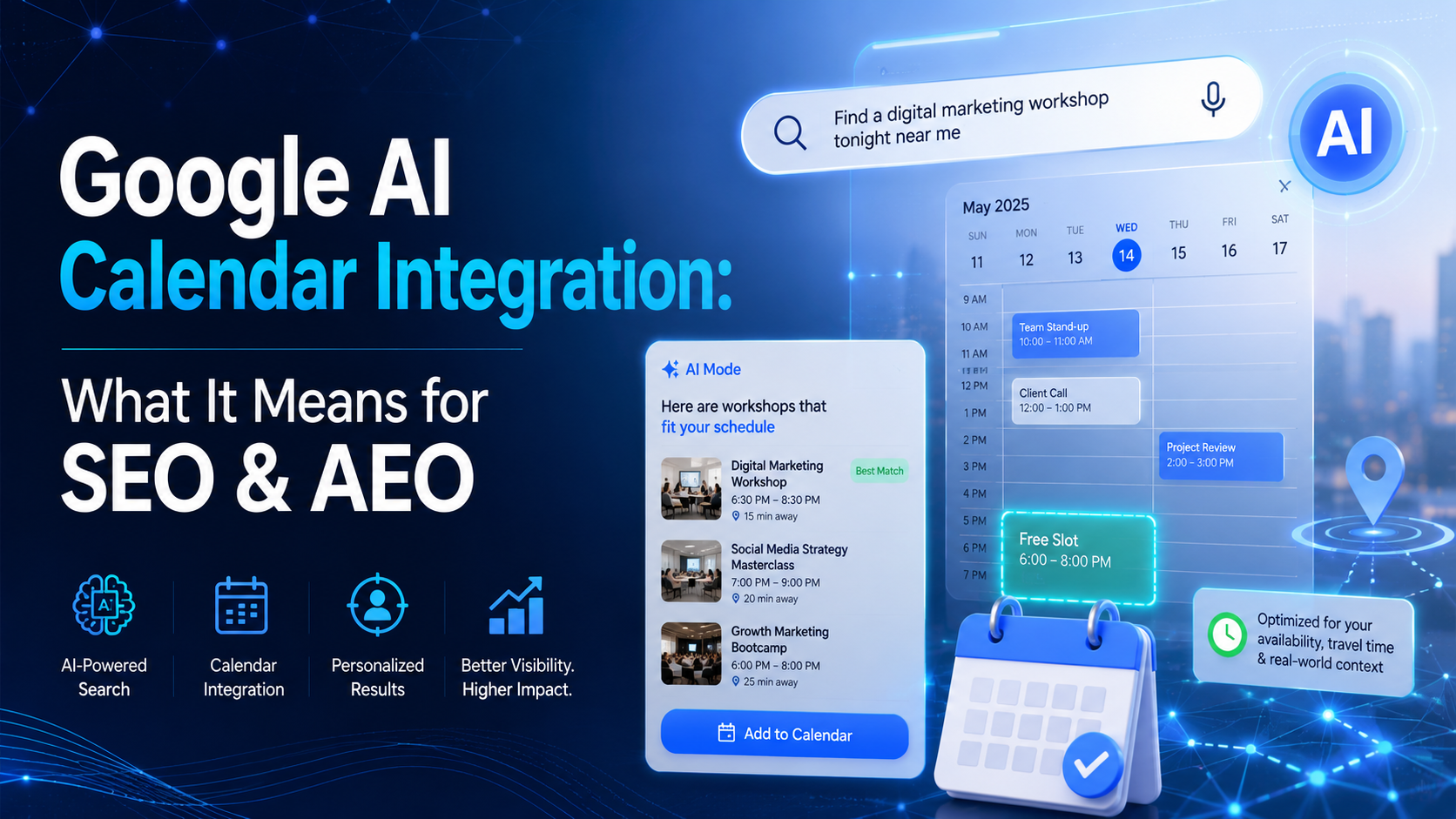
The latest improvements in Google’s technologies such as AI Mode and Personal Intelligence made search even more personalized than ever before. Now not only is Google able to comprehend the essence of the queries users type, but it also understands the context-when, where and how these results could be useful for the user. The ability to get recommendations based on Google Calendar data with user’s consent is one of the latest achievements.
For business it is one more step to take along the path of evolution of search. Not ranking first anymore is not enough; companies have to make sure that they are the most relevant option for a certain situation.
Now let us talk more about the Calendar integration of Google and its future in AI-based search.
What Is Google AI Mode Personal Intelligence?
Google AI Mode Personal Intelligence makes AI suggestions more relevant by using both general information from the web and information the user shares about themselves from their Google Workspace ecosystem.
It does not just give the same response to all but tries to tailor its suggestions according to context like:
- ➯ Availability on calendar
- ➯ Location
- ➯ Time of day
- ➯ User preferences
- ➯ Search intent
- ➯ Other Google services the user has linked and given permission to
While the idea is to answer questions, the main focus is to give personalized answers according to the circumstances of the user.
Instead of giving a suggestion like:
“The top-rated SEO agencies in Kochi are…”
Google AI mode could answer:
“You have two hours available today. Here are the agencies in your vicinity and available for you.”
This shows a huge change in approach from standard search to personalized suggestions.
How Does AI in Google’s Calendar Integration Work?
AI does not simply look up information on the internet. Rather, it integrates information across different sources to create more personalized answers for the user.
Although Google is still refining these functions, here are some of the basics behind how this process works in three easy steps.
1. Identifying the User’s Context
The user could say:
“Is there any digital marketing workshop I can attend tonight?”
Rather than simply looking up workshops, AI figures out whether the user even has time available.
Assuming that the user has elected to link his or her Workspace, AI factors in:
- ➯ Calendar events already scheduled
- ➯ Time slots available
- ➯ User’s location
- ➯ Travel time
- ➯ Operating hours of businesses
This provides a much deeper insight into the user’s context prior to making recommendations.
2. Ranking Results based on Availability
After AI understands the user’s schedule, it analyzes the possibilities available.
Consider two classes scheduled to start at 6:00 PM.
Class A:
- ➯ 10 minutes away
- ➯ Space available
- ➯ Perfectly fits into the user’s schedule
Class B:
- ➯ 45 minutes away
- ➯ Commences even before the user is done with another meeting
Even if Class B is more highly rated, AI may opt for Class A since it aligns well with the user’s situation.
This shows how personalization goes beyond keywords or rankings. Timing can be one of the factors used in ranking.
3. Enabling Users To Act On Information
Google is progressively making efforts to decrease the gap between discovering and acting upon information.
Instead of users having to:
- ➯ Search several sites
- ➯ Go through their options
- ➯ Go to Google Calendar
- ➯ Manually create the event
AI can help streamline the process by allowing the user to organize his plan in a better way with user consent for activities like creating calendar events.
It makes for a smoother process and decreases friction during the entire search process.
Real-World Example of Hyper-Personalized Search
Take Sarah, for instance, who is preparing to give a presentation for her client.
She is free for just one hour from 3:00 PM to 5:00 PM and seeks professional help regarding AI visibility for her firm.
Instead of entering into the search bar:
“SEO agency near me”
She asks Google AI Mode:
“I need to book an SEO consultation this afternoon prior to 6 PM appointment.”
Rather than giving her 10 blue links, AI considers numerous factors:
- ➯ Available time in Sarah’s schedule
- ➯ Location of nearby agencies
- ➯ Working hours of businesses
- ➯ Distance to the office
- ➯ Time required for meetings
- ➯ Traffic at the moment
The answer would be something like this:
“MindBees is open right now and is about 15 min away from you. Given your schedule, you can visit a 1-hour long consultation and make it on time to your next meeting.”
See what happened?
Recommendations weren’t based only on SEO rankings. They were affected by the customer’s available schedule.
It is just one of those personalized services that Google is planning to offer soon.
Why This Will Change Search Forever
In the previous few decades, search engines were mostly about indexing websites and ranking them according to relevance.
The algorithm was somewhat constant.
Companies have been investing in:
- ➯ Keyword optimization
- ➯ Quality content
- ➯ Backlinks
- ➯ Technical SEO
- ➯ Local SEO
All these remain significant today.
But AI-based search adds another dimension to personalization.
Two individuals searching for the exact same service may get different suggestions, depending on the differences in their situations.
Take this case for example:
Person A
- ➯ Available from 2 pm till 5 pm
- ➯ Close to downtown area
Person B
- ➯ Busy till 6 pm
- ➯ 30 km far from downtown
Despite the fact that both search:
“Best digital marketing agency”
Different companies may be suggested by the AI engine due to the fact that their situation differs.
Search Engine to Personal Assistant
Google has always been there to help users access information.
AI Mode elevates this concept as it helps users in making decisions.
As against simply presenting businesses, AI is more focused on answering queries like the following:
- ➯ Which one suits my schedule?
- ➯ Which business is currently open?
- ➯ Which service will I be able to contact before my next meeting?
- ➯ Which suggestion suits me at this time?
This shift changes the whole meaning of search engines from information providers to decision-makers.
The relevance factor for businesses does not only rely on search queries anymore, but it also requires relevancy with respect to the user’s current status.
Traditional SEO vs. AI-Powered Personalized Search
| Factor | Traditional SEO | AI-Powered Personalized Search |
| Primary ranking signals | Keywords, backlinks, content quality | User intent, context, availability, business relevance |
| Results | Similar for users with comparable searches | Highly personalized for each individual |
| User journey | Search → Website → Decision | Search → AI Summary → Recommendation → Action |
| Business visibility | Depends on search rankings | Depends on relevance, trust, structured data, and contextual fit |
| Goal | Increase website traffic | Become the most helpful answer for a specific user |
Traditional SEO isn’t disappearing.
Instead, it is becoming one part of a much larger ecosystem where AI evaluates multiple signals before recommending a business.
What Does This Mean for Digital Marketing?
With the advent of AI-assisted personalization, companies need to rethink their strategies regarding online presence.
Being the first result on Google can help, yet it doesn’t ensure that your company will become a recommendation provided by AI.
New questions have emerged:
- ➯ Can AI understand what your company does?
- ➯ Is there enough structured information on your site?
- ➯ Are your business hours correct?
- ➯ Does AI find it easy to decide if you’re relevant to a user’s needs?
Those companies will succeed which can be easily understood, verified and recommended by AI.
Companies will need to not only adapt their strategies to search engines but also adapt to the AI systems summarizing information and making decisions based on it.
That’s when Answer Engine Optimization (AEO) comes into play.
How to Optimize Your Brand for Google’s AI Search Mode
With AI search getting more personal, businesses should change their optimization approach. Rather than just ranking highly, businesses need to become the most relevant and reliable option for a certain user at a certain moment.
Below are five tips that will help prepare your business for Google’s developing AI mode.
1. Let AI Get an Understanding of Your Business
The information needed by AI to have a full understanding of what your business offers and whether it is accessible right now needs to be well-structured.
Make sure your website contains:
- ➯ Business hours information
- ➯ Contact data
- ➯ Areas of operation
- ➯ Bookings/scheduling possibility
- ➯ Google My Business schema markup
- ➯ Organization & Service schemas if relevant
For instance, if users are asking for a web development company that can conduct a consultation today, AI first needs certain information to decide whether you are the best option.
2. Produce Content to Provide Relevant Answers
AI uses content in a different way from how traditional searches are used by people. While they used to search for something like:
“SEO agency Kochi”
Nowadays, they ask about things like:
- ➯ “Who will make my website more visible to AI before launching my product?”
- ➯ “Which digital marketing company can help me grow search in my area?”
- ➯ “Do I have somebody who can do a website audit for me this week?”
Such questions show real challenges and not just some keywords.
Producing blogs, FAQs, and landing pages that would answer such questions is how AI understands when you are the right choice. That is what Answer Engine Optimization (AEO) is all about.
3. Make Your Business Information Uniform Across All Platforms
AI does not depend only on your website. It uses various sources of information to verify details about your business. Ensure your business information is uniform on:
- ➯ Google My Business page
- ➯ Social media accounts
- ➯ Various business directories
- ➯ Review platforms
- ➯ Industry directories
In case if there are differences in your working hours, phone number, services offered etc. on various websites, AI might be less certain about recommending your business.
4. Establish Authority Outside of Your Website
Authority has been a critical factor for search engines since day one, and it remains so for today’s AI-based systems. Creating valuable content for your website is an important step, but you must show your authority through the broader internet landscape.
Some examples include:
- ➯ Contributed articles for reputable websites
- ➯ Digital PR campaigns
- ➯ Interviews with experts
- ➯ Industry publications
- ➯ Speaking to podcasts
- ➯ Networking in professional groups
The more often your company name is linked to your industry, the more influential your online presence will become.
5. Concentrate On Helping People To Act
Action-oriented search via AI is becoming more and more common. In addition to merely referring a person to a website, AI wants to make their life easier. Ask yourself questions like:
- ➯ Is it simple to book an appointment?
- ➯ Can users easily contact your team?
- ➯ Are your services understandable?
- ➯ Is your website mobile-ready?
- ➯ Are the critical pages navigable?
Friction reduction will not only provide better user experience, but will also increase chances of getting recommendation from AI when a person is ready to take action.
Mistakes for Businesses to Avoid in Relation to AI Search
Despite the ongoing evolution of AI search, numerous businesses are still following old SEO approaches. Here are some mistakes that should be avoided.
Keywords Over Everything Else
Keywords matter but repetition of phrases is no longer of any help to you. Thus, one needs to focus on creating content that actually answers the users’ queries.
Forgetting about Structured Data
Without adequate schema markup, AI systems will have less information about your company. Schema markup allows one to give additional explanations regarding products/services provided by a business, its location and business hours, user reviews and other relevant information.
Posting Same Old Content
Nowadays, many websites tend to publish the same AI-generated content. One needs to post unique insights and information, give practical advice and examples from experience.
Neglecting the Maintenance of Business Information
Outdated hours, incorrect contacts or outdated pages decrease credibility. Thus, one should regularly monitor and update information on their website.
Future of Personalized Search
Integration of Google Calendar into the search demonstrates the trend toward contextual search. It means that AI can get acquainted with the personal context of the search before providing recommendations.
That’s why companies have to modify their strategies, and not only concentrate on rankings. It means that it will be vital to create websites which are:
- ➯ Understandable by AI
- ➯ Filled with good quality information
- ➯ Of value for the user
- ➯ Enable real-life actions
SEO will remain a key part of digital marketing but will coexist with structured data, conversational content, entities optimization and user experience.
Those companies who will be using these trends right now will have an edge in the future of AI-based search.
Frequently Asked Questions
➯ What is Google AI Mode Personal Intelligence?
Google AI Mode Personal Intelligence offers customized results by using the internet and approved context based on connected Google services. Its purpose is to offer more suitable answers based on personal needs and situations.
➯ Will Google AI have access to my Google Calendar automatically?
No. Personal data from Google Workspace can be accessed only if you grant it access. You will decide which services you want to connect, and what kind of context AI will use to customize its answers.
➯ Will traditional SEO become unnecessary?
No.
Technical SEO, good quality content, backlinks, and user experience are still the ranking factors. However, businesses need to be prepared for AI-based search.
➯ What is Answer Engine Optimization (AEO)?
Answer Engine Optimization (AEO) involves creating content that AI engines are able to digest, synthesize and incorporate in their answers to the questions asked by users.
➯ How can businesses get ready for AI-enabled search?
Businesses should:
- ➯ Keep the website information updated and correct.
- ➯ Use structured data.
- ➯ Create useful and conversational content.
- ➯ Develop authority on trusted sites.
- ➯ Build websites that facilitate taking action for users.
All these practices will help businesses increase visibility in both traditional and AI-based search results..
Conclusion
Searches are now entering a new age of more personalized searches. In the case where Google uses Calendar data in order to carry out its AI-based searches, it is evident that search engines are shifting from being information retrieval engines to become decision-making tools according to user needs and schedules.
It therefore means that instead of visibility depending on search rankings, visibility will depend on firms becoming the most relevant, reliable and accessible option to clients.
From the above observations, it is evident that firms which prepare themselves through preparing their websites using structured data and answer-based content have a better chance of surviving the transition. However, even when technology will continue changing, there will always be one thing which remains constant and that is firms which solve people’s problems will always earn their trust.
Get Ready for The Next Generation of Search Engines with MindBees!
Search engines powered by AI technology have transformed the way people are searching for information about companies and making decisions. To keep up in the competition, companies need more than just classical SEO tactics. They need to be prepared for search engine optimization on both the classical and AI fronts.
At MindBees, we offer assistance to businesses looking to adjust to the changing times, providing services ranging from technical SEO and answer engine optimization (AEO) to structured data implementation and even AI-focused digital marketing. Our combined experience and know-how in optimizing business’ presence online allows us to provide effective services in the new era of search engines.