


The landscape of search engine marketing is constantly shifting. Just when SEO experts and PPC strategists feel they’ve mastered the latest algorithm change, Google introduces a seemingly small tweak that ends up having massive implications. Recently, the tech giant rolled out a subtle yet profound visual overhaul to how advertisements appear on its Search Engine Results Page (SERP). This change isn’t about bidding wars or Quality Score mechanics; instead, it’s a foundational update to the user experience that fundamentally alters how users perceive, and interact with, paid content.
This quiet revolution gives the user more control than ever before. For everyone involved in digital marketing, from small business owners to enterprise marketers, this means one thing: the pressure on ad quality, relevance, and value has just escalated dramatically.
Part I: The New Anatomy of the Transparent SERP
To begin with, let’s clearly define what has changed. For years, paid placements on Google Search were marked by a small, often discreet “Sponsored” tag located near the top of each individual ad. These tags, while compliant with transparency guidelines, were sometimes easy to overlook, blending into the surrounding search results.
However, the new design is far more explicit and assertive.
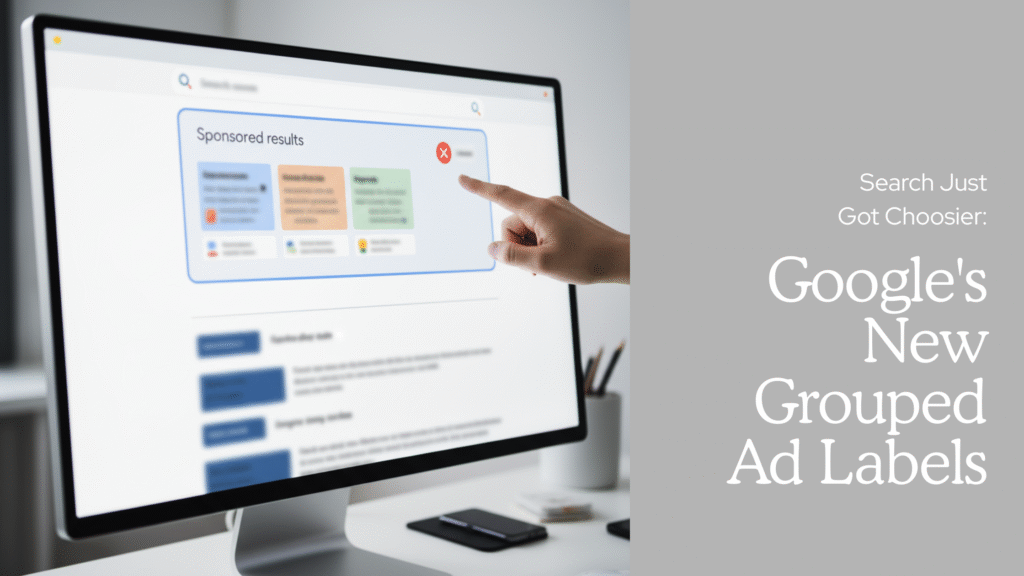
Google has now moved away from tagging each ad individually. Instead, all text advertisements are grouped together under a single, highly visible header that reads “Sponsored results.” This header stays put, acting as a clear bracket that visually segments the entire paid block from the organic listings that follow. This unified approach extends to other formats as well; for instance, Shopping placements are now consistently labeled as “Sponsored products.”
Furthermore, the most noticeable addition is the inclusion of a new, powerful element: the ability to collapse the entire ad block with one click via a “Hide sponsored results” option. This is a significant moment in the evolution of the SERP. Never before have users had such a simple, visible tool to dismiss all paid results in one action. This single button represents a massive shift in power dynamic, introducing a new user behavior that directly challenges the visibility advertisers rely upon.

Part II: Why Google Embraced the Trust Imperative
Why did Google make this shift? It’s not simply a cosmetic update. According to Google, these changes were driven by extensive user testing and feedback, aiming to create a more consistent and transparent experience across all platforms, both mobile and desktop. But the timing suggests a deeper, strategic motive related to maintaining user trust in an evolving search environment.
In recent times, the line between traditional organic results and commercially-motivated content has blurred, particularly with the introduction of generative AI features like AI Overviews. These AI-powered answers can appear above or alongside traditional search results. Consequently, Google must work harder than ever to prove that its search results are trustworthy.
By making the paid section unmistakably clear, Google is reinforcing a key message: Paid content is a part of the results, but we are giving you the ability to identify and control it. This focus on clarity is paramount. Therefore, increasing transparency is an investment in long-term user confidence in the search engine itself. If users feel they are being tricked into clicking an ad, they may stop trusting the platform entirely. This redesign is a preventative measure, signaling that paid placements can be both highly visible and entirely ethical, as long as they are clearly and unequivocally labeled.
Part III: The Advertiser’s New Challenge: The Quality Imperative
From a technical perspective, it is important to assure advertisers that the fundamental mechanics of the Google Ads platform are unchanged. Bidding strategies, Quality Score calculations, Ad Rank, and the maximum number of ads displayed (typically four) remain exactly as they were. However, while the engine remains the same, the road has new obstacles.
The grouping of ads and the new “Hide” option introduce two critical challenges:
Challenge 1: The Intent Filter
Users who are merely researching or casually browsing are now more likely to be visually prompted to dismiss the entire ad block. As a result, low-intent search queries could see a significant drop in ad engagement. The difference between a curious user and a ready-to-buy customer is now starker than ever.
On the other hand, users with high commercial intent-those searching for “emergency plumber near me” or “best CRM software pricing”-are less likely to collapse the sponsored section, as they are actively seeking a solution. This shift forces advertisers to relentlessly focus on matching search intent with precision.
Challenge 2: The Need for Hyper-Relevance
If a user chooses not to hide the sponsored results, you have earned a fraction of a second of their attention. Your ad is now grouped with your competitors, not just sequentially placed. Consequently, your ad must be a masterpiece of clarity and value. This environment puts immense pressure on the quality of the ad itself. Generic or weak ad copy will now serve as a prime reason for the user to hit that “Hide” button. Clear value propositions, compelling benefits, and an airtight alignment with the user’s query are no longer best practices-they are survival requirements.
Part IV: Actionable Strategy: Adapting to the Transparent SERP
The good news is that advertisers who prioritize quality and relevance are best positioned to succeed in this new environment. Here are four actionable steps every PPC professional should take immediately:
- ➯ Aggressively Monitor CTR Segmentation: Do not just look at your overall Click-Through Rate (CTR). Specifically, analyze your CTR broken down by query intent. Are performance drops concentrated on broad-match keywords? This segmentation will reveal exactly which searches are generating the highest abandonment rates and guide your campaign adjustments.
- ➯ Double Down on Value-Driven Ad Copy: Test, test, and re-test your headlines and descriptions. Focus on expressing a unique selling proposition (USP) immediately. Rather than just describing your product, explain the benefit to the user. For example, instead of “Our New Shoes,” try “Free Returns & Next-Day Shipping on All New Shoes.”
- ➯ Refine Your Targeting and Negatives: Now is the time to audit your negative keyword lists. You want to eliminate waste and prevent your ad from appearing for any search where the user is clearly not ready to buy. Furthermore, leverage audience targeting (such as remarketing lists) to focus on users who have already shown some intent with your brand.
- ➯ Prioritize Top-of-Block Placement: While visibility alone is no longer enough, ranking in the first position within the “Sponsored results” block is more valuable than ever. When a user chooses not to hide the ads, the first result they see must be highly compelling. If your campaigns are not consistently achieving top position for your most valuable keywords, consider incremental adjustments to your Quality Score and bids.
For organizations that lack the in-house expertise to navigate these nuances-especially the complex interplay between ad copy, user intent, and platform updates-it is a smart strategic move to seek professional help. A dedicated specialist can quickly implement these changes, ensuring ad spend is optimized for the new transparent SERP. If you are looking for a reliable partner, consider Mindbees IT solutions for professional digital marketing services. Their team can provide the strategic oversight and execution needed to maintain performance and help you hire PPC expert talent.
Conclusion: Visibility vs. Trust
Google’s redesign of its search ad labels is a clear statement: visibility is earned through trust. The core functionality of the ad auction hasn’t changed, but the presentation-and thus the user’s psychological response-has. The new rule of paid search is simple: when transparency becomes mandatory, quality becomes non-negotiable. Advertisers who embrace this truth by focusing on relevance, value, and precise intent matching will not only maintain their performance but will thrive as the search engine continues to evolve.