
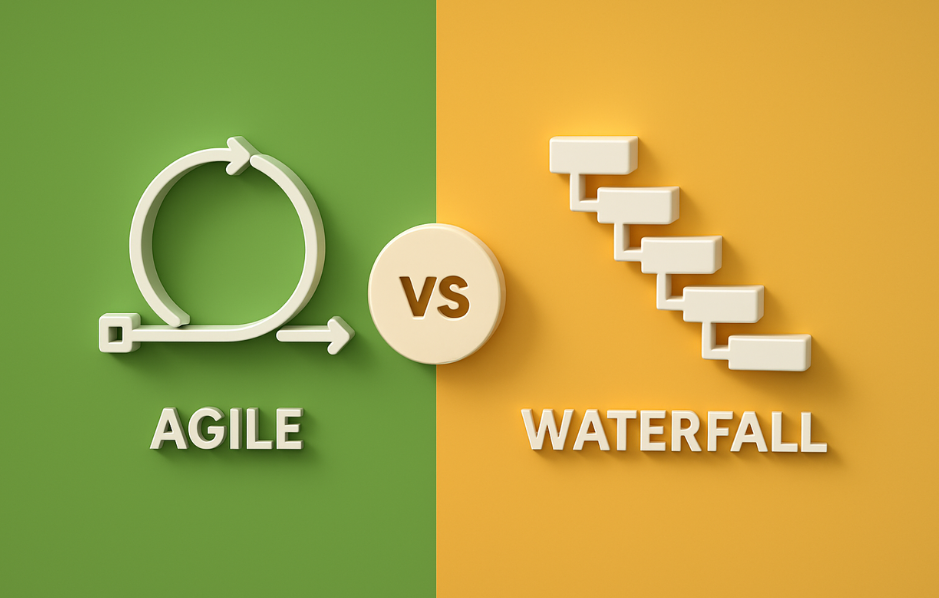


Selecting between Agile and Waterfall for your software project is a defining decision that impacts timelines, costs, and success. Each methodology brings unique strengths, challenges, and ideal use cases, and your choice depends on project scope, team dynamics, and adaptability requirements. Leveraging years of experience across startups and enterprise systems, combined with insights from recent industry studies, this guide dissects both approaches, highlights their strengths, and equips you with practical tools to make an informed decision. Through clear comparisons, real-world examples, and visual aids, let’s explore the best path for your project.
Understanding Agile and Waterfall: The Foundations
- ➔ Agile and Waterfall represent two distinct approaches to software development. Waterfall follows a linear, sequential process where phases – requirements gathering, system design, coding, testing, and deployment – are completed one after another, with each phase finalized before the next begins, similar to constructing a building with fixed blueprints. This structured method ensures clarity and predictability, ideal for projects with stable requirements.
- ➔ Agile, rooted in the 2001 Agile Manifesto, emphasizes iterative development and collaboration, delivering small, functional software increments in short cycles (sprints of 1-4 weeks) that adapt based on user feedback. It’s like sketching a prototype, testing it, and refining it iteratively, making it perfect for dynamic environments with evolving needs.
- ➔ To summarize: Waterfall offers a rigid, predictable structure but struggles with mid-process changes; Agile embraces adaptability but risks scope creep. Waterfall suits smaller, specialized teams, while Agile thrives with cross-functional, collaborative groups. Here’s a concise comparison:
| Feature | Waterfall | Agile |
| Structure | Linear, sequential phases | Iterative, cyclical sprints |
| Adaptability | Changes are costly post-planning | Embraces evolving requirements |
| Team Fit | Suits small, structured teams | Best for cross-functional crews |
| Predictability | Fixed scope, clear timelines | Flexible scope, variable timelines |
Waterfall: Strength in Structure and Predictability
- ➔ In 2015, I worked on a healthcare compliance system where strict regulations, like HIPAA, required precise requirements upfront. Waterfall was the ideal choice. We dedicated weeks to mapping every data flow, user interaction, and compliance checkpoint before coding, resulting in a stable rollout on a fixed budget with minimal rework.
- ➔ Waterfall excels in projects with well-defined, unchanging requirements, such as embedded systems for automotive software or government contracts with strict specifications. Its phased approach produces thorough documentation, essential for audits, regulatory compliance, or handoffs to maintenance teams. For instance, in aerospace, where safety standards lock in specs early, Waterfall’s predictability is critical.
- ➔ The downside is its lack of flexibility. If a client requests a change after the design phase – like altering a user interface – it can trigger costly revisions across earlier phases, similar to relocating a load-bearing wall mid-construction. This makes Waterfall less ideal for projects where requirements may shift.
Agile: Embracing Flexibility and Iteration
- ➔ In 2020, during the peak of the pandemic, I led a telehealth app project where user needs shifted weekly – from virtual consultations to billing integrations. Agile’s iterative approach enabled us to release minimum viable products (MVPs) every two weeks, incorporating user feedback through virtual testing, keeping the app relevant in a fast-moving market.
- ➔ Agile shines in dynamic settings like startups or consumer-facing apps, where user feedback drives features like gamified fitness trackers or social media tools. Frameworks like Scrum, with daily stand-ups, or Kanban, with visual task boards, foster tight collaboration, catch issues early, and enhance team morale. The 2020 Standish Group Chaos Study found Agile projects succeed at a 64% rate compared to Waterfall’s 49%, a trend continuing into 2025.
- ➔ However, Agile requires discipline to avoid pitfalls like scope creep from unchecked feedback loops, which can stall progress, or reliance on disengaged clients who bottleneck sprints. It also demands a cultural shift, as teams must embrace frequent communication and iterative delivery, which can challenge those accustomed to rigid structures.
Comparing Agile and Waterfall: Key Decision Factors
- ➔ Flexibility in Requirements: Waterfall’s predictability is ideal when requirements are fixed, but its rigidity makes changes costly, as redesigning a feature can inflate budgets. Agile treats change as a strength, perfect for fintech apps navigating new regulations or competitive shifts, allowing pivots without derailing the project.
- ➔ Team Dynamics and Collaboration: Waterfall suits small, specialized teams with clear roles, like developers handing off to testers, minimizing overlap. Agile requires cross-functional teams where designers, coders, and product owners collaborate closely, thriving on autonomy and frequent check-ins, but it can struggle with siloed or less collaborative groups.
- ➔ Project Scope Clarity: For projects with a fixed scope, like upgrading a payroll system, Waterfall ensures a streamlined process with clear deliverables. Agile suits evolving scopes, such as social media platforms where user feedback refines features iteratively, aligning with market demands.
- ➔ Timeline and Budget Control: Waterfall locks in costs and deadlines upfront, making it ideal for fixed-budget contracts like government projects. Agile’s flexibility can extend timelines as features evolve, but it delivers value faster via early MVPs. A 2023 PMI study notes Agile projects deliver usable software 30% faster on average, though Waterfall offers tighter cost control.
Hybrid Models: Blending Structure with Agility
- ➔ As projects grow complex, hybrid models combining Waterfall’s structure with Agile’s flexibility are gaining traction. A 2025 survey found 24% of IT professionals using hybrids, up from prior years, citing improved risk management in regulated industries. This “Agifall” approach applies Waterfall for upfront planning and compliance gates, then Agile sprints for development and testing.
- ➔ For example, a U.S. federal agency building workflow apps used Waterfall for high-level governance and requirements, then switched to Agile for coding and feedback, balancing regulatory needs with speed. An insurance firm reported hybrids delivered value faster than pure Waterfall, with 71% of organizations blending elements for balanced outcomes.
- ➔ Hybrids require skilled project management to avoid confusion between methodologies but excel in scenarios like enterprise systems, where core infrastructure demands stability while user-facing features benefit from iteration.
Avoiding Pitfalls: Common Mistakes and How to Sidestep Them
- ➔ Waterfall projects often fail when teams skimp on upfront requirements, leading to costly late-stage discoveries – 30% of failures stem from this oversight. Treating phases as fully siloed, ignoring early team input, also hurts morale and quality. To mitigate, enforce rigorous phase reviews and involve key stakeholders throughout.
- ➔ Agile’s pitfalls include scope creep from unchecked feedback loops, affecting 70% of teams and turning iterative progress into indefinite delays. Skipping training causes 61% of failures, as teams misinterpret Agile as “no rules.” Counter this with strict sprint goals, tools like Jira for focus, and comprehensive Agile training.
- ➔ Hybrids amplify these risks, needing clear handoffs to prevent “methodology whiplash.” Regular alignment meetings and defined phase transitions keep teams synchronized.
Real-World Scenarios: Where Each Model Shines
- ➔ Waterfall Success: A medical device firmware project with non-negotiable specifications and regulatory oversight benefits from Waterfall’s structured approach, ensuring a robust audit trail and compliance.
- ➔ Agile Success: A consumer fitness app shaped by user feedback on features like workout tracking or gamification thrives with Agile’s iterative cycles, staying competitive in a crowded market.
- ➔ Hybrid Success: Large enterprise systems blend Waterfall for stable core infrastructure and Agile for user-facing modules, balancing predictability with adaptability, though this requires skilled coordination.
Decision Framework: Choosing the Right Path
- To select the best model, evaluate these factors:
- ➔ Scope Stability: Fixed scope (e.g., payroll system)? Choose Waterfall. Evolving scope (e.g., social media app)? Go Agile.
-
- ➔ Stakeholder Engagement: Agile requires active client input for feedback loops; Waterfall can proceed with minimal involvement.
-
- ➔ Team Composition: Cross-functional, collaborative teams suit Agile; specialized, structured teams align with Waterfall.
-
- ➔ Budget and Timeline: Waterfall ensures cost and deadline predictability; Agile prioritizes early value but risks timeline creep.
-
- ➔ Regulatory Needs: Waterfall’s documentation excels in compliance-heavy fields like healthcare or aerospace.
- If uncertain, a hybrid model or a pilot sprint can test the fit, using tools like Azure DevOps to bridge methodologies.
Conclusion: Tailoring the Approach to Your Project
- No methodology is a one-size-fits-all solution – Waterfall’s structured roadmap excels for projects with clear, fixed goals, while Agile’s adaptive nature thrives in dynamic, evolving environments. In 2025, Agile’s success rate, up to three times higher than Waterfall’s, makes it the go-to for fast-paced projects, yet Waterfall and hybrid approaches remain essential for structured or mixed requirements. Evaluate your project’s scope, team dynamics, and constraints to choose the best fit, and don’t hesitate to blend methodologies if it suits your needs. For tailored advice on applying these approaches, explore our development services or web development expertise. Share your project’s scope in the comments – let’s find the perfect approach for your next build!