
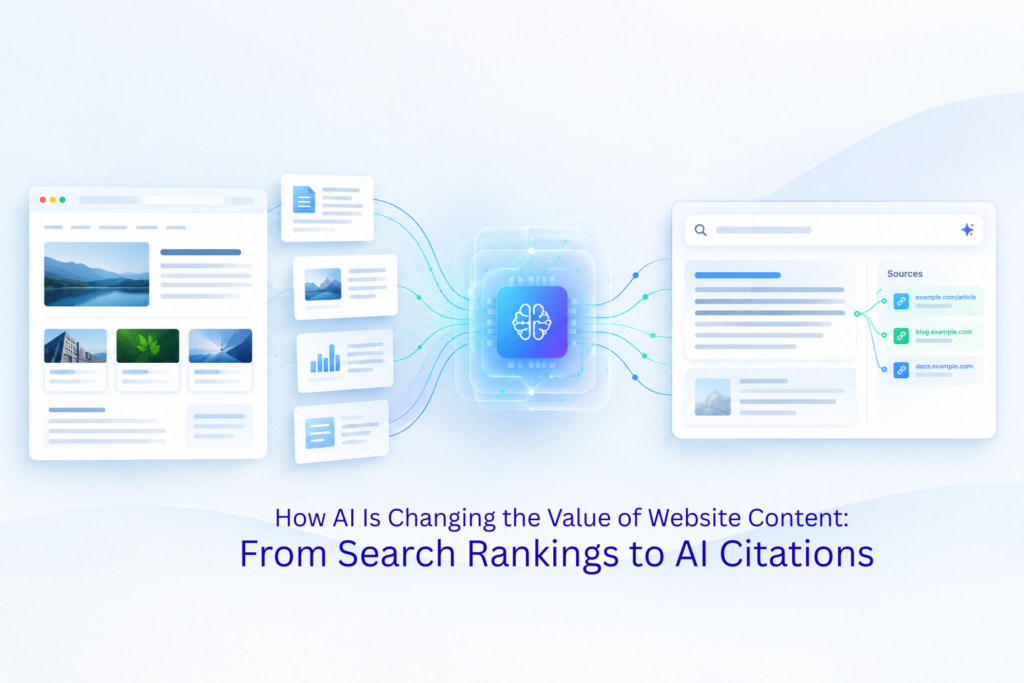


A few years back, the idea behind website content creation was quite straightforward.
Your aim was for your page to be displayed in the results of a search done by a user on Google. It had to rank well, have an appealing headline, useful content, and possibly clicks too.
But then things changed in search.
Google no longer just displayed a set of links but was beginning to answer questions directly. AI Overviews came into play. AI Mode became conversational. And other AI search engines like ChatGPT, Gemini, and Perplexity were also providing answers from information found on the internet.
This raised a new challenge for website owners:
What happens when people get the answer without visiting the website?
Well, there’s yet another development that’s made the issue even more intriguing.
According to reports in Search Engine Journal citing Digiday, Google is conducting trials with a system that will allow it to reward publishers whose content helps formulate AI-generated responses. The pilot project, conducted through Search Console and focusing on content helping form answers in Gemini, AI Overviews, and AI Mode.
As the name implies, one would think this is a story about compensation for publishers.
However, there’s something much larger implied here.
The worth of website content may be shifting from simply being discoverable through search to being helpful to the AI algorithms when creating an answer.
This is important for almost any company running a website.
From “Can Google Find My Page?” to “Can AI Use My Information?”
Let us consider a scenario where a user has a question.
They do not want to go through ten articles. They do not want to open twenty tabs. They just want to find an answer.
And so, they query an AI-driven search engine:
“What should a small business think about before building an AI-based customer support application?”
The engine will return a comprehensive answer.
However, it did not come out of thin air.
It was probably compiled from documentation, company websites, academic papers, product pages, professional articles, case studies, and other material available online.
This alters the function of a website.
Before, all that the website had to do was to attract the user searching.
Now, the content on the website will also have to educate the engine that answers the user’s query.
It is not to say that SEO as we knew it is no more. It is not.
Rather, it is broadening.
Content may need to:
- ➯ rank in standard search
- ➯ show up in AI-powered search features
- ➯ provide answers to user questions
- ➯ get cited as the source of information
- ➯ supply information that AI systems can interpret and make use of
- ➯ ultimately convert the visibility into traffic or inquiries about the brand
The documentation for Google’s Search Console actually now offers a report on “Generative AI Performance,” offering data on how websites perform in AI Overviews and AI Mode, along with impressions and the pages getting those impressions. Google claims that this report has been made available to all websites across the globe as of August 31, 2026.
Thus, this isn’t anymore just a hypothesis about the future.
The metrics on AI-driven search visibility have already become part of website performance reporting.
What Is Google’s AI Contribution Pilot?
What makes the recent Google pilot unique is that it seems to take it a step further.
As mentioned in the Search Engine Journal article, Google is testing a Search Console tool where publishers are paid for their content that “contributes significantly” to an AI-generated answer. It is worth noting the particularity of the distinction made in the article – the content that contributes to the formation of an answer in the process of its generation but is not included in it directly or is only linked is eligible for rewards.
The pilot program includes:
- ➯ Gemini
- ➯ Google AI Overviews
- ➯ Google AI Mode
Publishers who participate in the pilot reportedly receive an AI contribution panel in Search Console, including earnings and historical data. But at the same time, the algorithm of calculation remains somewhat concealed from the participants.
There is one thing that needs to be remembered about it.
It is a pilot project, not an entirely new way of universal payment to all websites.
Google confirmed the existence of such pilot project but it is too early to think about it as a permanent way of paying websites.
Nevertheless, such an approach deserves attention.
Why?
It raises one thing that businesses should be considering at the moment:
AI systems require valuable data and original content on websites can help with its generation.
Being Cited by AI Is Not the Same as Being Used by AI
This is where it starts to get a little bit trickier. Let’s say that the AI gives the answer and cites your website at the end.
What would go through your mind?
“Awesome. They cited my website.”
And that’s great. There is still another scenario.
Perhaps your information played a role in making the AI aware about the subject matter to formulate an answer, even though the answer may not be citing your website like one would expect from a traditional search.
These two go hand in hand, but are not quite the same.
| Traditional Search | AI-Powered Search |
| A page can rank for a query | Information can contribute to an AI-generated response |
| Users scan search results | Users may receive a direct answer |
| Clicks are a major goal | Visibility, citations and supporting information can also matter |
| Keywords are important | Questions, context, entities and topics matter |
| A page competes for position | Multiple sources may contribute to one response |
| Search rankings are easier to observe | AI visibility can be harder to measure |
This is one reason businesses should not treat AI visibility as simply another version of keyword ranking.
It requires a slightly different way of thinking.
So, What Makes Content Useful to AI?
There is no such thing as a special paragraph length, keyword density, or particular format that guarantees that your web page gets featured on ChatGPT, Gemini, Google AI Overviews, Perplexity, or any other AI platform.
A person who guarantees AI citations should be viewed skeptically.
But there are some things you can do to improve the clarity and usability of your information.
1. Answer the question clearly
If someone asks:
“What is AI-powered customer support?”
Do not make them read 800 words before finding the answer.
Give them a clear explanation first.
Then provide the details.
This simple approach helps both people and machines understand what the page is about.
2. Cover the topic properly
A page should not answer one narrow question and ignore everything around it.
For example, an article about AI customer support could naturally explain:
- ➯ what it is
- ➯ how it works
- ➯ common use cases
- ➯ benefits
- ➯ limitations
- ➯ implementation challenges
- ➯ security considerations
- ➯ cost factors
- ➯ how businesses can get started
The goal is not to make the article unnecessarily long.
The goal is to make it complete enough to be useful.
3. Add information that other websites do not have
This could very well be the most critical point.
If there are ten sites that provide the same information, adding another version that repeats the same information does not add any value.
Original research, examples, expert views, observations, data, case studies, experiences, and firsthand information can add some value to the content.
In other words:
Never repeat what others have written. Always add something.
4. Make facts easy to verify
In case there is an argument being made, it is necessary to explain its origins where applicable.
Make use of credible sources.
Refer to documentation whenever applicable. Ensure that the difference between a fact, observation, estimation, and opinion is clear. It improves credibility of the content for the reader.
5. Use clear structure
A wall of text is difficult for everyone.
Use:
- ➯ descriptive headings
- ➯ short paragraphs
- ➯ bullet points
- ➯ numbered steps
- ➯ comparison tables
- ➯ examples
- ➯ definitions
- ➯ FAQs
For example, instead of writing:
“AI-ready content requires businesses to consider a number of different factors…”
A heading such as:
What Makes Content AI-Friendly?
immediately tells the reader what comes next.
Good structure is not about writing for machines.
It is about making information easier to understand.
AI Citations: What Businesses Should Actually Aim For
AI Citation is gaining popularity in the sphere of digital marketing.
In other words, AI citation is a situation when the AI-generated answer cites or links to some source which backs up the information provided.
This can be good for business in particular.
Why?
Because the citation brings the brand to the person who would never find it in a regular search.
For instance, the user can ask:
“Who offers customized software development services for startups?”
If the AI website gives a list of such companies along with links to their web resources, then becoming one of such sources means getting new visibility.
But here’s the thing – there’s one significant drawback.
There’s simply no guaranteed way of getting your site cited by an AI tool.
They have different indexing, search, ranking algorithms, and methods of generating responses.
As such, what you should actually be asking yourself is not:
“How do I force AI to cite my page?”
But rather:
“How do I make my site a credible source of info?”
SEO, AEO and GEO: Do Businesses Need All Three?
As search changes, businesses are hearing new terms such as SEO, AEO and GEO.
They can sound complicated, but the basic idea is simple.
| Approach | Main Goal |
| SEO | Help search engines discover, understand and rank content |
| AEO | Provide clear answers to questions people ask |
| GEO | Improve how content can be discovered and represented in generative AI experiences |
These approaches overlap.
For instance, a good article may be:
- ➯ accessible for search engines technically;
- ➯ structured on actual questions;
- ➯ useful for people;
- ➯ scannable;
- ➯ informationally correct;
- ➯ relevant for AI-based answers;
SEO, AEO and GEO do not have to be completely different things. One good content strategy can work for all three at once.
Google Is Also Giving Website Owners More AI Visibility Data
But that’s not all.
Google has been adding more AI-focused controls and reports to Search Console.
Its Generative AI performance report gives data on the impressions of a site within AI Overviews and AI Mode. Site owners can filter performance by pages, countries, date range, and device types.
Google has also provided a Search generative AI control in Search Console.
As stated in Google documentation, site owners have the option to choose if their site’s links and contents will be used in Google’s generative AI features. If chosen, content can be shown as links and can also help in grounding the AI responses.
This means a major shift in the ways website visibility can be gauged.
Site owners no longer need to ask:
“How many clicks did I get?“
They now also ask:
“How often am I being featured in Google’s AI searches?“
This doesn’t mean that regular search reporting is done away with.
This just means an additional level.
What Should Businesses Do Now?
One does not have to immediately rewrite all the pages on their site due to AI.
It is possible to begin with the material that is already there.
Step 1: Discover your valuable questions
- ➯ Consider those questions that consumers really ask.
- ➯ Go beyond the help of keyword tools.
- ➯ Consult with the sales force.
- ➯ Consider customer service questions.
- ➯ Analyze customer communications.
- ➯ Search queries.
- ➯ Product reviews.
These questions may be used as some of the most valuable content topics.
Step 2: Review your existing pages
Ask:
- ➯ Does this page address the primary question?
- ➯ Is the significant information readily available?
- ➯ Are the descriptions clear?
- ➯ Are arguments backed up?
- ➯ Is the material original?
- ➯ Does this page provide any additional value to that which is available on other sites?
If the answer to several of these questions is no, there is certainly room for improvement.
Step 3: Build topic depth
Do not publish dozens of articles with only one or two keyword variations when you can publish resourceful content that addresses related issues.
Here is an illustration:
- ➯ AI Software Development
- ➯ can relate to issues such as:
- ➯ AI application development
- ➯ AI chatbot development
- ➯ AI automation
- ➯ integration of machine learning
- ➯ AI product development
- ➯ AI security
- ➯ challenges of AI implementation
Step 4: Make the business itself clear
Visibility of AI does not mean blogging alone.
Your website must clearly state:
- ➯ who you are
- ➯ what you do
- ➯ who your target audience is
- ➯ what services you offer
- ➯ what technology you use
- ➯ how much experience you have
- ➯ and how you can be reached
This is important because a business website is more than just a compilation of blogs.
It is the medium through which information is linked to the organization.
Where Web Development and AI Services Come Together
Here is where content strategy comes into play and merges with technology.
Even though a company can have the best content, its website will not serve well if it is disorganized, not user-friendly, slow, unclear and technically poor.
The same goes for AI products.
Creating an AI-driven application is not just about implementing an AI model within a product.
An application should be easy to use, have good data flow, right integrations, smart workflows, take into account any technical issues and create a nice experience for a user.
That is why AI services and software development now need to collaborate more often.
This approach to AI services and development is considered at MindBees when we start to develop AI services and applications.
We don’t limit ourselves to just implementing AI in a product or producing content around some trendy AI topic.
We aim to build a valuable digital experience combining technology, development, user experience and business goals.
The same approach is used to design a company’s website and content.
The technology enables users to find and use the information.
Content communicates the company’s expertise.
And digital experience links all of that together.
A Simple AI-Ready Content Checklist
Before publishing an important article or service page, ask these questions:
Content
- ➯ Does the page answer a real question?
- ➯ Is the main answer clear?
- ➯ Does it provide original value?
- ➯ Are important claims supported?
- ➯ Does it avoid unnecessary repetition?
Structure
- ➯ Are the headings descriptive?
- ➯ Are paragraphs easy to scan?
- ➯ Are lists or tables useful here?
- ➯ Are related questions answered naturally?
- ➯ Is the page easy for a reader to follow?
Business information
- ➯ Is the author or business clear?
- ➯ Does the page explain relevant expertise?
- ➯ Are services described accurately?
- ➯ Are important company details consistent?
Technical foundation
- ➯ Can search engines access the page?
- ➯ Is the canonical URL correct?
- ➯ Are important pages indexable?
- ➯ Is structured data used where appropriate?
- ➯ Does the page work well across devices?
AI visibility
- ➯ Is the topic relevant to questions people may ask AI systems?
- ➯ Does the page provide information worth referencing?
- ➯ Are there original insights or useful examples?
- ➯ Are you monitoring AI-related search visibility where data is available?
This is not a checklist for “tricking” AI.
It is a checklist for creating a better website.
Will AI Citations Replace Website Traffic?
Certainly not.
At least, there is no cause to believe that all search activity will simply vanish.
Individuals will still visit websites when they require specific information, wish to compare various products, contact a company, view documents, make purchases or research a firm.
While at the same time, some searches might eventually lead to an answer generated by an AI.
It means that firms have to consider both sides of the process.
An individual can learn about your firm through the answer provided by AI.
He or she can visit your website.
Or can get information about your firm within the AI service and remember it later.
Or your material can help an AI to generate answers even without clicking on it by the user.
The importance of visibility is getting harder to quantify in one figure.
The Bigger Change: Content Is Becoming Part of the Answer
Now go back to your customer and ask a question.
A few years ago, he/she could use Google, open some pages, compare the data, and choose what to believe.
Today, he/she can ask an artificial intelligence system and get a full answer in just a few seconds.
Behind this answer lies an information ecosystem.
⇲ Websites are still important.
⇲ Research is still important.
⇲ Experts are still important.
⇲ Explanations are still important.
⇲ Information is still important.
The only thing that changes is the path from content to consumer.
What is exciting about Google’s AI contribution pilot is not only that publishers might get paid. What is exciting about it is that it underlines the increasing importance of content that helps to produce an answer.
At the same time, Google Search Console is offering website owners new opportunities to measure their visibility within AI search experiences.
Which means that what companies should be asking themselves is not only:
“Why aren’t we ranking well enough?”
It is increasingly:
“What information are we creating that humans and AI systems can understand, rely on, and use?”
This opens up a much larger opportunity.
And companies that begin considering their websites, content and digital products from this perspective now will be better positioned to take advantage of what is coming next in search.